Tia Portal V11 Sp2 Update 5 Download -

Tia Portal V11 Sp2 Update 5 Download -

Tia Portal V11 Sp2 Update 5 Download

Tia Portal V11 Sp2 Update 5 Download -

And then the narrative looped: the world moved on, new requirements whispered by production planners, new components waiting in supplier catalogs. Another version number would be born, another two-letter prefix and a sequence of decimal updates. Through them, the living system of code and copper and human patience continued to be rewritten in small, meaningful acts: downloads that were promises; updates that were conversations between people and machines.

Behind the name lived an ecosystem of humming racks and patient PLCs. "Tia Portal" was less a program than a room—an industrial cathedral whose stained-glass windows were HMI screens, where dozens of machines recited the same choreography every morning. V11 stood for a lineage refined through years of stubborn fixes and pragmatic features; SP2 hinted at a second season in the software’s life, and Update 5 was its small, deliberate breath—a decimal footstep toward resilience.

There is poetry in deferred updates. Update 5 sat in waiting lists, attached to tickets; it became a question: do you patch now, or do you wait for better windows? The answer was a balance of probability and courage. In one plant they pressed install and felt the system exhale; in another they postponed, living with known faults like old friends. Both choices were honest. Tia Portal V11 Sp2 Update 5 Download

The narrative split into quiet lives. In a suburban garage, an engineer with grease under her nails read the terse release notes over coffee: bug fixes to logic blocks, improved library stability, an obscure note about memory allocation in legacy S7 projects. She imagined phantom race conditions no one had yet seen, and imagined solutions along with the ghosts. Across town, a site manager frowned—downtime schedules already carved into the week. A downloaded file meant a weekend at the plant, tools laid like a surgeon’s instruments, backups verified as sacrament.

So the link labeled "Tia Portal V11 SP2 Update 5 Download" was more than a command. It was a hinge between past complacency and future steadiness—a quiet invitation to intervene, to choose, to shepherd an orchestra of motors and memory toward one more day without surprise. And then the narrative looped: the world moved

There are versions that arrive with trumpets and webinars; there are those that slip in like a locksmith at dawn. This was the locksmith. The download link was a key. Whoever clicked it knew they would carry more than a file back to the plant: they would ferry expectation and risk. Patches mend, but they also rearrange. A single patched line could stop a stubborn conveyor or coax a sensor into reading truth where it had lied for months.

When the update finally settled across servers and panels, it left small traces: an eliminated alarm here, a faster compile there, a happier log file. Operators noticed things without being able to say why—less noise on the floor, a trendline that no longer jagged. The changelog’s terse line—“stability improvements, bug fixes”—became, in practice, a modest act of stewardship. The software, like any artifact molded by many hands, had been nudged toward better shape. Behind the name lived an ecosystem of humming

Yet updates are also acts of trust. The download woven into corporate policy, checksums verified by scripts, a chain of custody documented more meticulously than many financial transactions. The update’s journey—downloaded, staged, tested in a sandbox, deployed—was a liturgy of precaution. In that ritual, small dramas played out: a virtual machine complaining about disk space, a testbench revealing a race condition under improbable load, a late-night call that ended with a sigh and the word "defer."

They called it V11 SP2 Update 5 at the edge of a midnight repository—an innocuous string of characters that smelled faintly of firmware and fluorescent lights. It arrived the way all important things arrive now: in a dim notification, an unreadable changelog, a checksum like a riddle. To most people it was just a link to download; to a certain kind of technician it was a promise and a question.

There was a third presence: machines themselves. They do not know about versions in human terms, but they respond to changes. A small servo burrowed into the update and found its timing smoothed; a formerly jittery actuator settled as if reassured by a lullaby. An HMI theme, once stubbornly slow, brightened with a subtle UI optimization, making a tired operator blink and find commands where they had expected absence. Somewhere, a forgotten esoteric bug in a communications driver dissolved and freed a string of alarms that had been silently ignored for months.
And then the narrative looped: the world moved on, new requirements whispered by production planners, new components waiting in supplier catalogs. Another version number would be born, another two-letter prefix and a sequence of decimal updates. Through them, the living system of code and copper and human patience continued to be rewritten in small, meaningful acts: downloads that were promises; updates that were conversations between people and machines.

Behind the name lived an ecosystem of humming racks and patient PLCs. "Tia Portal" was less a program than a room—an industrial cathedral whose stained-glass windows were HMI screens, where dozens of machines recited the same choreography every morning. V11 stood for a lineage refined through years of stubborn fixes and pragmatic features; SP2 hinted at a second season in the software’s life, and Update 5 was its small, deliberate breath—a decimal footstep toward resilience.

There is poetry in deferred updates. Update 5 sat in waiting lists, attached to tickets; it became a question: do you patch now, or do you wait for better windows? The answer was a balance of probability and courage. In one plant they pressed install and felt the system exhale; in another they postponed, living with known faults like old friends. Both choices were honest.

The narrative split into quiet lives. In a suburban garage, an engineer with grease under her nails read the terse release notes over coffee: bug fixes to logic blocks, improved library stability, an obscure note about memory allocation in legacy S7 projects. She imagined phantom race conditions no one had yet seen, and imagined solutions along with the ghosts. Across town, a site manager frowned—downtime schedules already carved into the week. A downloaded file meant a weekend at the plant, tools laid like a surgeon’s instruments, backups verified as sacrament.

So the link labeled "Tia Portal V11 SP2 Update 5 Download" was more than a command. It was a hinge between past complacency and future steadiness—a quiet invitation to intervene, to choose, to shepherd an orchestra of motors and memory toward one more day without surprise.

There are versions that arrive with trumpets and webinars; there are those that slip in like a locksmith at dawn. This was the locksmith. The download link was a key. Whoever clicked it knew they would carry more than a file back to the plant: they would ferry expectation and risk. Patches mend, but they also rearrange. A single patched line could stop a stubborn conveyor or coax a sensor into reading truth where it had lied for months.

When the update finally settled across servers and panels, it left small traces: an eliminated alarm here, a faster compile there, a happier log file. Operators noticed things without being able to say why—less noise on the floor, a trendline that no longer jagged. The changelog’s terse line—“stability improvements, bug fixes”—became, in practice, a modest act of stewardship. The software, like any artifact molded by many hands, had been nudged toward better shape.

Yet updates are also acts of trust. The download woven into corporate policy, checksums verified by scripts, a chain of custody documented more meticulously than many financial transactions. The update’s journey—downloaded, staged, tested in a sandbox, deployed—was a liturgy of precaution. In that ritual, small dramas played out: a virtual machine complaining about disk space, a testbench revealing a race condition under improbable load, a late-night call that ended with a sigh and the word "defer."

They called it V11 SP2 Update 5 at the edge of a midnight repository—an innocuous string of characters that smelled faintly of firmware and fluorescent lights. It arrived the way all important things arrive now: in a dim notification, an unreadable changelog, a checksum like a riddle. To most people it was just a link to download; to a certain kind of technician it was a promise and a question.

There was a third presence: machines themselves. They do not know about versions in human terms, but they respond to changes. A small servo burrowed into the update and found its timing smoothed; a formerly jittery actuator settled as if reassured by a lullaby. An HMI theme, once stubbornly slow, brightened with a subtle UI optimization, making a tired operator blink and find commands where they had expected absence. Somewhere, a forgotten esoteric bug in a communications driver dissolved and freed a string of alarms that had been silently ignored for months.
Powerful tools for the system trader

Tia Portal V11 Sp2 Update 5 Download
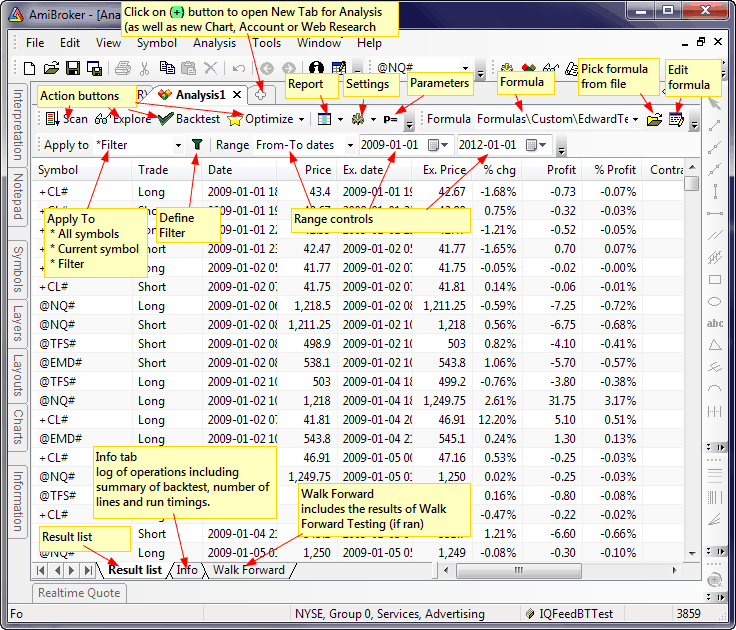
The Analysis window

The Analysis window is home to all your scans, explorations, portfolio backtests, optimizations, walk-forward tests and Monte Carlo simulation

Screen markets for opportunities

Exploration is multi-purpose screening/data mining tool that produces fully programmable tabular output with unlimited number of rows and columns from all symbols data

Test your system

The Backtest allows to test your system performance on historical data. The simulation is performed on portfolio-level as in real-life, with multiple securities traded at the same time, each having user-definable position sizing rule.

Scoring & ranking

If multiple entry signals occur on the same bar and you run out of buying power, AmiBroker performs bar-by-bar ranking based on user-definable position score to find preferable trade.

Find optimum parameter values

Tell AmiBroker to try thousands of different parameter combinations to find best-performing ones. Use Smart Artificial Intelligence Optimization (Particle Swarm and CMA-ES) to search huge spaces in limited time.

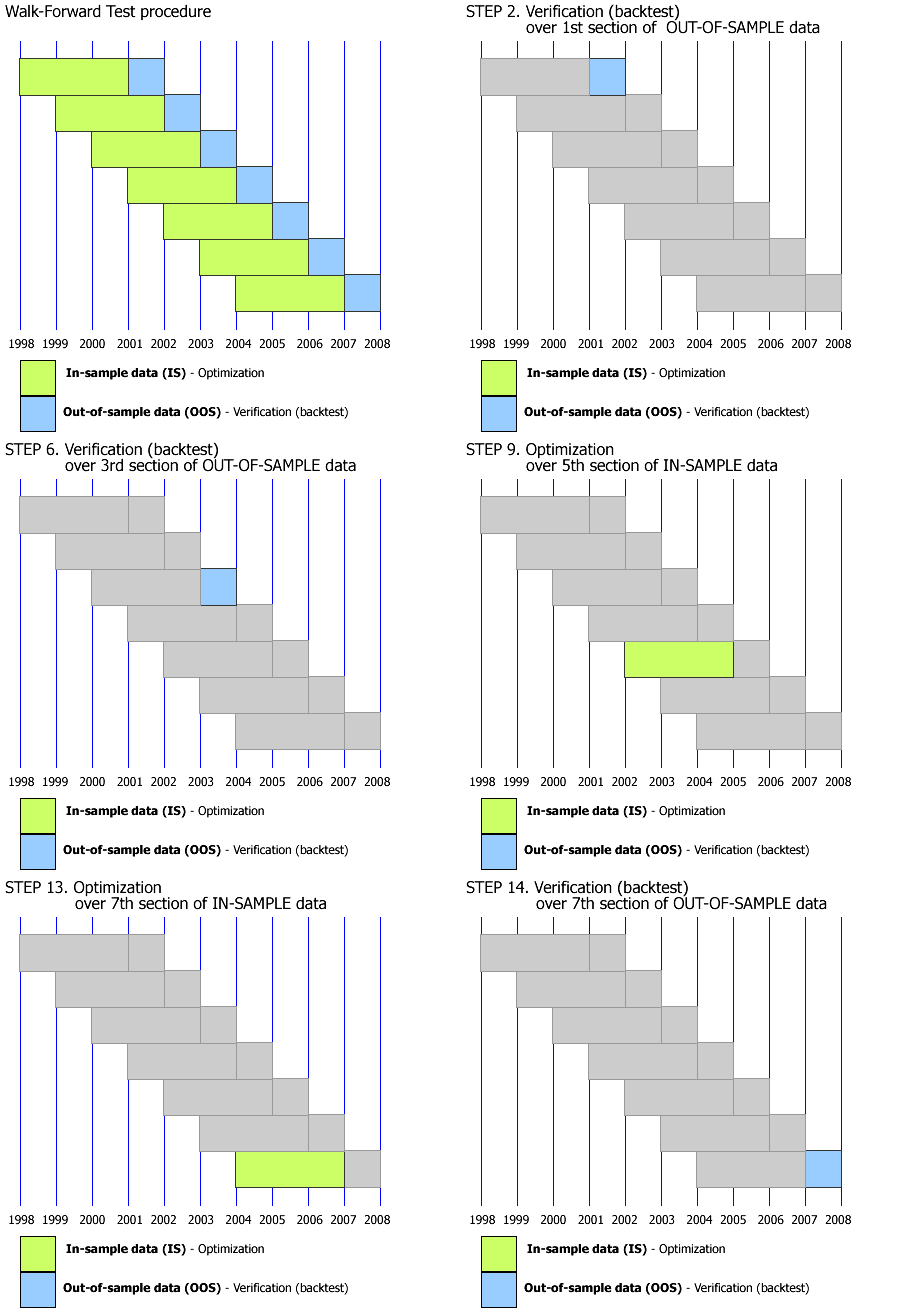
Walk-forward testing

Don't fall into over-fitting trap. Validate robustness of your system by checking its Out-of-Sample performance after In-Sample optimization process.

Tia Portal V11 Sp2 Update 5 Download
Tia Portal V11 Sp2 Update 5 DownloadTia Portal V11 Sp2 Update 5 Download
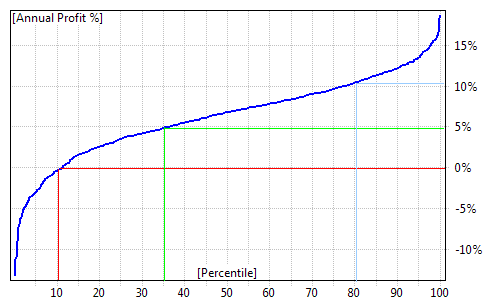
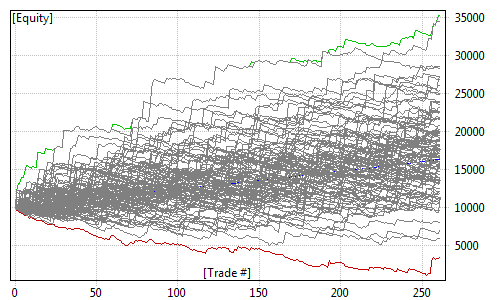
Monte Carlo Simulation

Prepare yourself for difficult market conditions. Check worst-case scenarios and probability of ruin. Take insight into statistical properties of your trading system

Concise and fast formula language to express your trading ideas

Tia Portal V11 Sp2 Update 5 Download
Fast array and matrix processing

In AmiBroker Formula Language (AFL) vectors and matrices are native types like plain numbers. To calculate mid point of High and Low arrays element-by-element you just type MidPt = ( H + L )/2; // H and L are arrays and it gets compiled to vectorized machine code. No need to write loops. This makes it possible to run your formulas at the same speed as code written in assembler. Native fast matrix operators and functions make statistical calculations a breeze.

Concise language means less work

Your trading systems and indicators written in AFL will take less typing and less space than in other languages because many typical tasks in AFL are just single-liners. For example dynamic, ATR-based Chandelier's stop is just:ApplyStop( stopTypeTrailing, stopModePoint, 3* ATR(14), True, True );

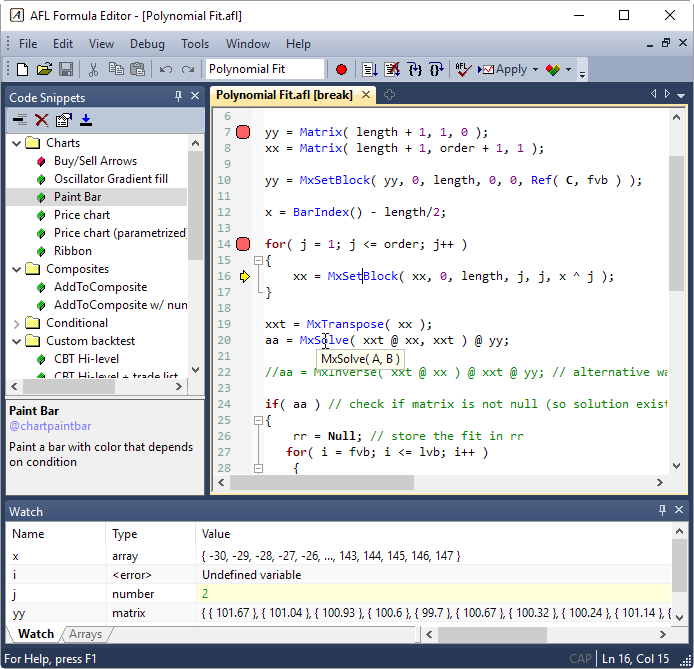
Built-in debugger

The debugger allows you to single-step thru your code and watch the variables in run-time to better understand what your formula is doing

State-of-the-art code editor

Enjoy advanced editor with syntax highlighting, auto-complete, parameter call tips, code folding, auto-indenting and in-line error reporting. When you encounter an error, meaningful message is displayed right in-line so you don't strain your eyes

Less typing, quicker results

Coding your formula has never been easier with ready-to-use Code snippets. Use dozens of pre-written snippets that implement common coding tasks and patterns, or create your own snippets!

Multi-threading

All your formulas automatically benefit from multiple processors/cores. Each chart formula, graphic renderer and every analysis window runs in separate threads.

Three AmiBroker editions to choose from

299  Buy
Standard Edition
Includes 24 months of free upgrades & support

Entry-level version for End-of-day and swing traders. End-of-day and Real time. Intraday starting from 1-minute interval. 10 symbols limit in Real time Quote window. 2 simultaneous threads per Analysis window. 32-bit only.

379  Buy
Professional Edition
Includes 24 months of free upgrades & support

Professional Real-Time and Analytical platform with advanced backtesting and optimization. End-of-day and Real time. All Intraday Tick/Second/Minute intervals, Unlimited symbols in Real time Quote window. Unlimited symbols in Time&Sales. MAE/MFE stats included. Up to 32 simultaneous threads per Analysis window. Includes both 64-bit and 32-bit versions.

499  Buy
Ultimate Pack Pro
Includes 24 months of free upgrades & support

Everything that AmiBroker Professional Edition has plus two very useful programs:
AmiQuote - quote downloader from multiple on-lines sources featuring free EOD and intraday data and free fundamental data.
AFL Code Wizard - creates AFL formulas out of plain English sentences. Invaluable learning tool for novices. (AmiQuote and AFL Code Wizard licenses are worth $198 when purchased separately so you save 8% when buying this pack)

All our licenses are perpetual which means you can buy once and use the version that you purchased forever. They also come with 24-month free upgrades, support and maintenance which means that you will be able to upgrade to the newest version during that period at no cost. All licensed users are also entitled to receive 50% discount on upgrade purchases past free upgrade period.

System requirements: Microsoft Windows 11, 10, 8.1, 7 (SP1) at least 1GB RAM. Apple Mac users can use Bootcamp / Parallels / VMWare to run AmiBroker.