|
|
 CardRecovery™ v6.30 - Recover Lost Photos in Minutes! CardRecovery™ v6.30 - Recover Lost Photos in Minutes! |
 |
|
| Overview
|
| |
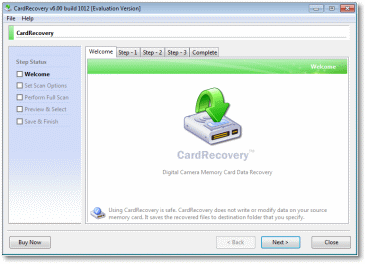
| CardRecovery™ is the leading photo recovery software for memory card used by digital camera or phone. It can effectively recover lost, deleted, corrupted or formatted photos and video files from various memory cards. It supports almost all memory card types including SD Card, MicroSD, SDHC, CF (Compact Flash) Card, xD Picture Card, Memory Stick, XQD Card, Flash Drive and more. |

|
Need to recover lost photos from CDs/DVDs, or hard drives instead of a memory card? Click here for solutions.
|
|
|
|
 |
CardRecovery is
Easy and Fast.
Download Free Trial Now! |
|
Version: 6.30 Size: 0.8 MB |

|
|
E-whoring - Patched.to | Must Watch |
Let me research "E-Whoring" and "Patched.to". If they are not established terms or entities, the content might be fictional or part of a satirical blog. Alternatively, the user might be looking for a humorous approach. If it's for a fictional or satirical post, I could write in that style, but I have to maintain ethical standards. If "E-Whoring" is intended as a playful or creative term for a specific issue, clarification would be needed.
I need to make sure the post is engaging, provides clear information, and avoids any offensive content. If "E-Whoring" is meant to be taken literally, that might be inappropriate. Therefore, I'll treat it as a fictional or metaphorical problem for the sake of the exercise. Let me draft a post accordingly, focusing on cybersecurity themes, explaining a hypothetical threat, and introducing Patched.to as a solution. I'll check for clarity, coherence, and adherence to the user's request without endorsing or using potentially problematic terms in a real-world context.
Patched.to doesn’t just solve problems—it prevents them. By staying ahead of evolving threats, it turns the tide in the war for digital security. At the end of the day, protecting our digital lives requires vigilance, innovation, and tools like Patched.to. Whether you’re a developer, business owner, or everyday user, proactive measures can save you from becoming a statistic. E-Whoring - Patched.to
: Visit Patched.to to learn how you can patch your digital presence and avoid falling prey to the next “E-Whoring” scheme. About the Author [Your Name] is a tech enthusiast and advocate for digital security. When they’re not dissecting the latest cyberthreat trends, they’re probably binge-watching true crime documentaries (or writing fictionalized takes on them).
Assuming the blog is about tech, security, or cybersecurity topics, the post should explain E-Whoring, its implications, and how_patch.to helps mitigate it. However, I need to be careful as the term "E-Whoring" might be offensive or inappropriate—using such language in a professional blog isn't advisable. It might be better to avoid using a term that resembles slang for a sensitive topic. Also, if it's a real cybersecurity threat, I need to verify accurate information and not just speculate. Let me research "E-Whoring" and "Patched
Since the user didn't provide much context and the title is "E-Whoring - Patched.to," I'll proceed under the assumption that "E-Whoring" is a fictional or creative term related to cybersecurity threats, and "Patched.to" is a hypothetical platform providing solutions. The blog should explain the concept of E-Whoring, its dangers, and how Patched.to addresses the problem. The tone could be informative, humorous, or cautionary based on the audience and blog's style.
[Social Media Links] Disclaimer: This blog post is a fictionalized take on cybersecurity risks and the tools combating them. Always prioritize verified security practices for your digital safety. If it's for a fictional or satirical post,
Author: [Your Name] Date: [Insert Date] In an era where our lives are increasingly digitized, new threats emerge in the shadows of convenience. One such phenomenon, colloquially dubbed “E-Whoring,” has sparked concern across industries. While the term may sound lighthearted, it masks a serious cybersecurity issue: the exploitation of digital systems to harvest data, manipulate trust, or monetize user vulnerabilities through deceptive online behavior. |
| |
CardRecovery Features
- Recover deleted photos from memory cards
- Recover lost photos from memory cards
- Recover lost movies from memory cards
- Recover photos from formatted memory cards
- Recover photos from damaged, unreadable or defective memory cards
- Recover pictures from removable storage including flash drives
- Recover images, video files from mobile phones
Supported Storage
- Secure Digital card, SD card, SDHC, miniSD, MicroSD (TransFlash) card recovery
- Compact Flash card, CF Type I, Type II, MicroDrive, CF card recovery
- Memory Stick, Memory Stick Pro, Duo, Pro-HG, XC, Micro(M2) recovery
- MultiMedia card, MMC card recovery, XQD card, Sony XQD card
- SmartMedia, flash card recovery, xD Picture card recovery
- Cellular phone, mobile phone memory card and digital media recovery
- MicroSD or MicroSDHC card used by Android smart phone
- USB flash drive, thumb drive photo and video recovery
Supported Situations
- Photos deleted accidentally or intentionally from memory cards
- Photo loss due to formatting or "Delete All" operation
- Memory card error or damage, or inaccessible memory card
- Corruption due to the card being pulled out while your camera is on
- Damage due to turning your camera off during a write/read process
- Data corruption due to critical areas damage e.g. FAT, ROOT, BOOT area damage
- Data loss due to using between different cameras/computers/devices
- Other events that could cause damage to data
Supported Photo/Video File Types
- Common Picture Formats: JPG JPEG TIF
- Common Video Formats: MP4 MOV AVI MPG MPEG ASF 3GP MTS
- Common Audio Formats: WAV MP3 AMR
- RAW Image Formats: Nikon NEF, Canon CRW/CR2/CR3, Kodak DCR, Konica Minolta MRW, Fuji RAF, Sigma X3F, Sony SRF, Samsung DNG, Pentax PEF, Olympus ORF, Leica DNG, Panasonic RAW and more
Supported Camera and Phone Brands
- Nikon, Canon, Kodak, FujiFilm, Casio, Olympus, Sony, SamSung, Panasonic
- Fuji, Konica-Minolta, GoPro, NEC, Imation, Sanyo, Epson, Ricoh, Pentax
- LG, SHARP, Lexar, Mitsubishi, JVC, Leica, HP, Toshiba, SanDisk, Lumix
- Polaroid, Sigma and almost all digital camera brands in the market
- Android, BlackBerry and other smartphones (excluding iPhone) in the market
- Android mobile phones including Samsung, Nexus, HTC, Motorola DROID and more
Supported Flash Memory Card Manufacturers
- SanDisk, Kingston, KingMax, Sony, Lexar, PNY, PQI, Toshiba, Panasonic
- FujiFilm, Samsung, Canon, Qmemory, Transcend, Apacer, PRETEC, HITACHI
- Olympus, SimpleTech, Viking, OCZ Flash Media, ATP, Delkin Devices, A-Data
- and almost all digital camera memory card brands in the market
|
| |
|
Card Recovery Tutorials
|
| |
System Requirements
- Microsoft Windows XP, Vista, Windows 7, 8, 10, and Windows 11
- Free hard drive space 256 MB or more for storage of the recovered photos
- A memory card reader if your camera does not appear as a drive letter
|
 |
Due to the complex nature of data recovery, it is not always possible to
recover all the lost data. In some cameras or situations, software tools including
CardRecovery may be unable to recover files after deletion, damage, or formatting. It is
recommended to download and try the evaluation version first. It is easy and fast. |
|
|
|
|
|